Those things still matter enormously. But now there is another factor rising rapidly up the agenda for schools: sustainability.
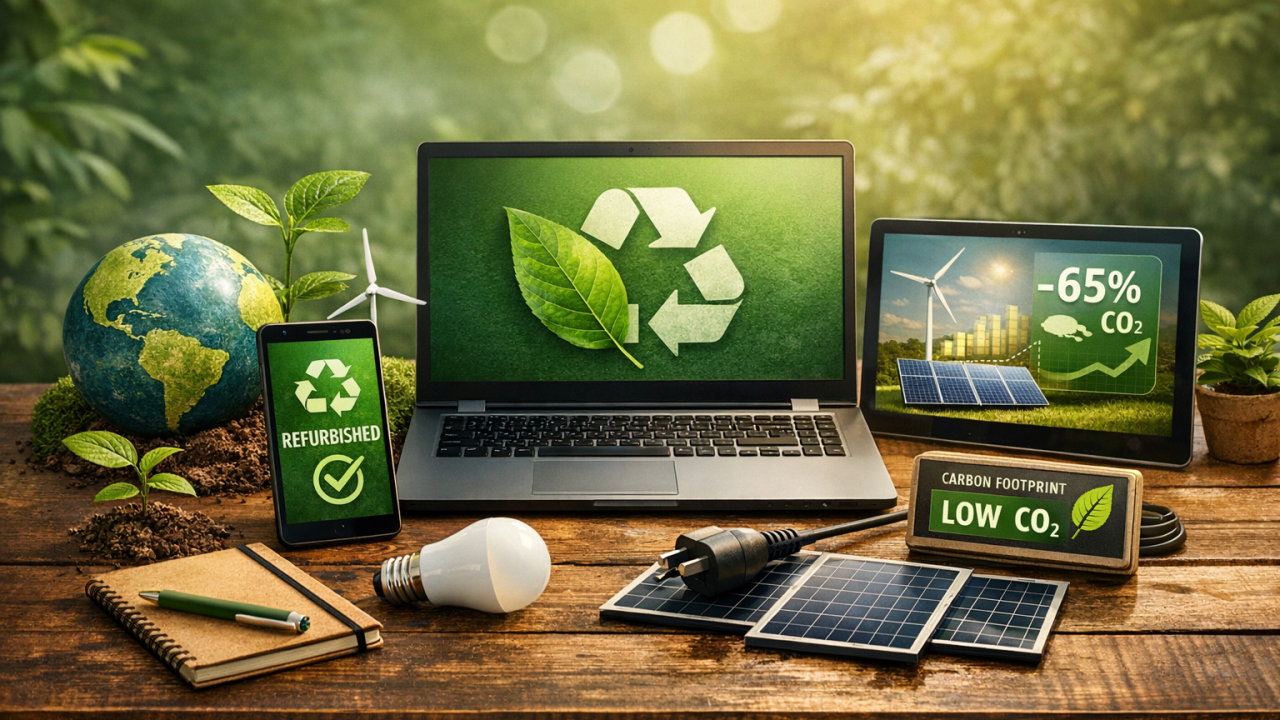
The future of 1:1 is not simply digital. It is carbon-conscious.
Schools are under growing pressure to modernise while also demonstrating social value, responsible procurement and environmental awareness. A well-designed 1:1 programme can now do all three. That is why carbon-conscious 1:1 schemes are no longer a “nice to have” — they are quickly becoming the future of education technology.
The hidden carbon cost of “new”
Every new laptop has an environmental cost long before it reaches a classroom. Raw material extraction, manufacturing, assembly, packaging and transport all contribute to its footprint.
That matters because, in many cases, the largest share of a device’s carbon impact happens before a student even switches it on for the first time. Lenovo’s published product carbon footprint sheet for the ThinkPad L13 Yoga Gen 2, for example, puts the lifecycle footprint at roughly 495 kg CO2e for the assessed model. Even if schools work on a slightly lower model-specific estimate, the key point is the same: buying new carries a substantial upfront carbon cost.
Refurbishment changes the equation
This is where a carbon-conscious 1:1 programme becomes so powerful.
When a school chooses a professionally refurbished device instead of a newly manufactured one, it is extending the life of existing technology rather than triggering a fresh round of manufacturing emissions. Put simply, the carbon-heavy part has already happened. The device already exists. The smarter, more sustainable decision is to keep high-quality hardware in circulation for longer.
That is circular economy thinking in action — and it is exactly the direction the sector is moving in.
Sustainability no longer has to mean compromise
One of the old myths around refurbished devices is that schools have to sacrifice reliability, appearance or confidence.
That simply does not hold up when refurbishment is done properly.
Where the process is robust, devices go through detailed engineering checks, component testing, cosmetic refurbishment and quality control to bring them back to a standard that is fit for the classroom. In the model you are building around, devices go through a 66-point engineering inspection and aesthetic refurbishment. That matters, because trust is everything in a parent-facing 1:1 offer.
It also matters that the wraparound support is strong. A three-year mechanical warranty, a three-year blemish/scratch warranty on the skins, and durable materials designed for long-term use help move the conversation from “second-hand” to “professionally renewed, protected and fit for purpose.” That is a very different proposition.
A better story for schools, trusts and parents
The strongest 1:1 programmes are not sold on hardware alone. They are sold on outcomes and confidence.
A carbon-conscious 1:1 offer gives schools a stronger story to tell:
every pupil still gets access to a reliable personal device
schools can improve affordability and inclusion
procurement becomes more environmentally responsible
the programme aligns with ESG, sustainability and trust-wide carbon goals
parents can see that the school is making a practical, values-led decision
That messaging is increasingly important. Programmes like HP Brighter Futures are already framing education technology around both digital access and environmental responsibility, with messaging such as “Powering Education. Protecting the Planet.”
The strongest 1:1 programmes will combine access, value and environmental impact
The next phase of 1:1 will not be driven by price alone.
It will be driven by a more rounded proposition: good devices, strong support, manageable costs, and a clearly evidenced environmental benefit.
That is exactly why carbon-conscious 1:1 is the future. It allows schools to meet digital learning goals without ignoring the climate reality behind technology procurement. It allows parents to invest in a device with greater confidence. And it allows providers to differentiate with a proposition that is practical, credible and future-facing.
In short, it is no longer enough to say a 1:1 programme works.
The question schools will increasingly ask is: does it work educationally, financially and environmentally?
In summary
If your school is exploring a 1:1 programme, now is the time to think beyond simply buying new. A carbon-conscious model can deliver the access students need, the reassurance parents want, and the sustainability outcomes schools are increasingly expected to show.
Because the future of 1:1 is not just one device per child.
It is one smarter, more sustainable decision at a time.